Recent posts
-
Visily Shuts Down in 2026: What Happened and the Best Alternatives for UI/UX Designers
November 11, 2026
-
Small Device, Big AI – What NVIDIA’s Jetson Orin Nano Super Makes Possible
October 31, 2026
-
PHP Security in Practice: Vulnerabilities, Defenses, and Secure Development
October 27, 2026
-
UI/UX Design With AI Tools: 7 Powerful Trends Transforming Product Design in 2026
September 17, 2026
-
AI Lead Generation in 2026: How to Turn Your Website Into a 24/7 Sales System
September 7, 2026
The AI-powered design industry has experienced another significant change. Visily, a popular AI-assisted wireframing and UI/UX design platform, officially shut down on October 31, 2026.
For designers, developers, startups, and product teams that relied on Visily to transform ideas into visual interfaces, the announcement marks the end of a useful design tool.
But why did Visily shut down? What happens to existing projects? And which tools can designers use instead?
In this article, we explore everything you need to know about the Visily shutdown, its impact on the UI/UX industry, and the best alternatives to consider in 2026.
What Was Visily?
Visily was an AI-powered UI/UX design platform designed to simplify the process of creating wireframes, mockups, and interactive prototypes.
Unlike traditional design software that often requires specialized design skills, Visily focused on making interface design accessible to everyone, including developers, product managers, business owners, and startup founders.
Its main capabilities included:
- AI-powered design assistance: Helping users generate and develop interface concepts.
- Wireframing and prototyping: Creating early-stage application and website layouts.
- Screenshot-to-design workflows: Using existing interface screenshots as design references.
- Prebuilt templates and components: Accelerating the design process.
- Team collaboration: Supporting communication and feedback throughout product design.
- Design export: Allowing users to export work into formats suitable for sharing or development.
For teams working on websites, SaaS applications, mobile apps, and digital products, Visily provided a straightforward way to visualize ideas before development began.
Why Did Visily Shut Down?
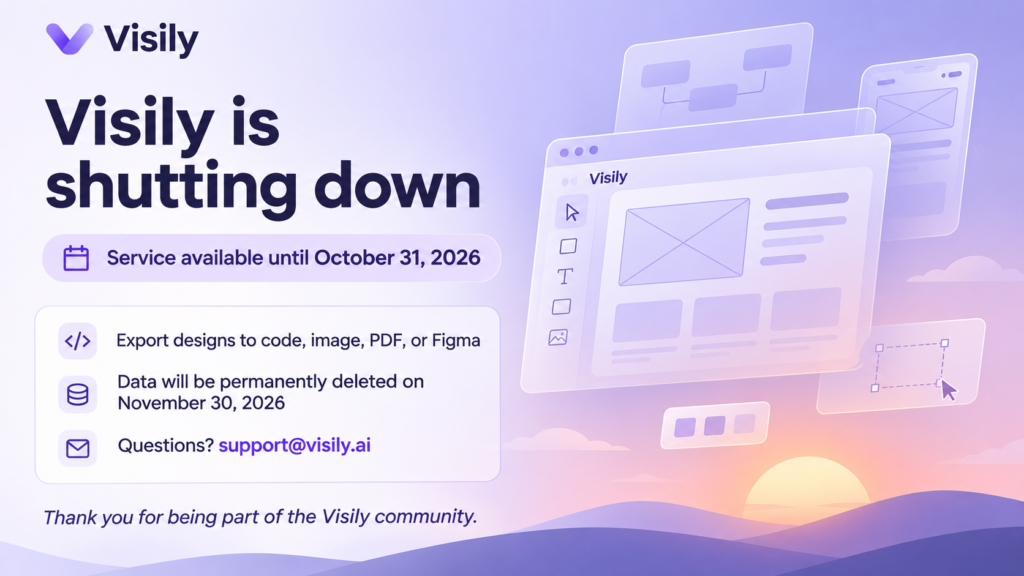
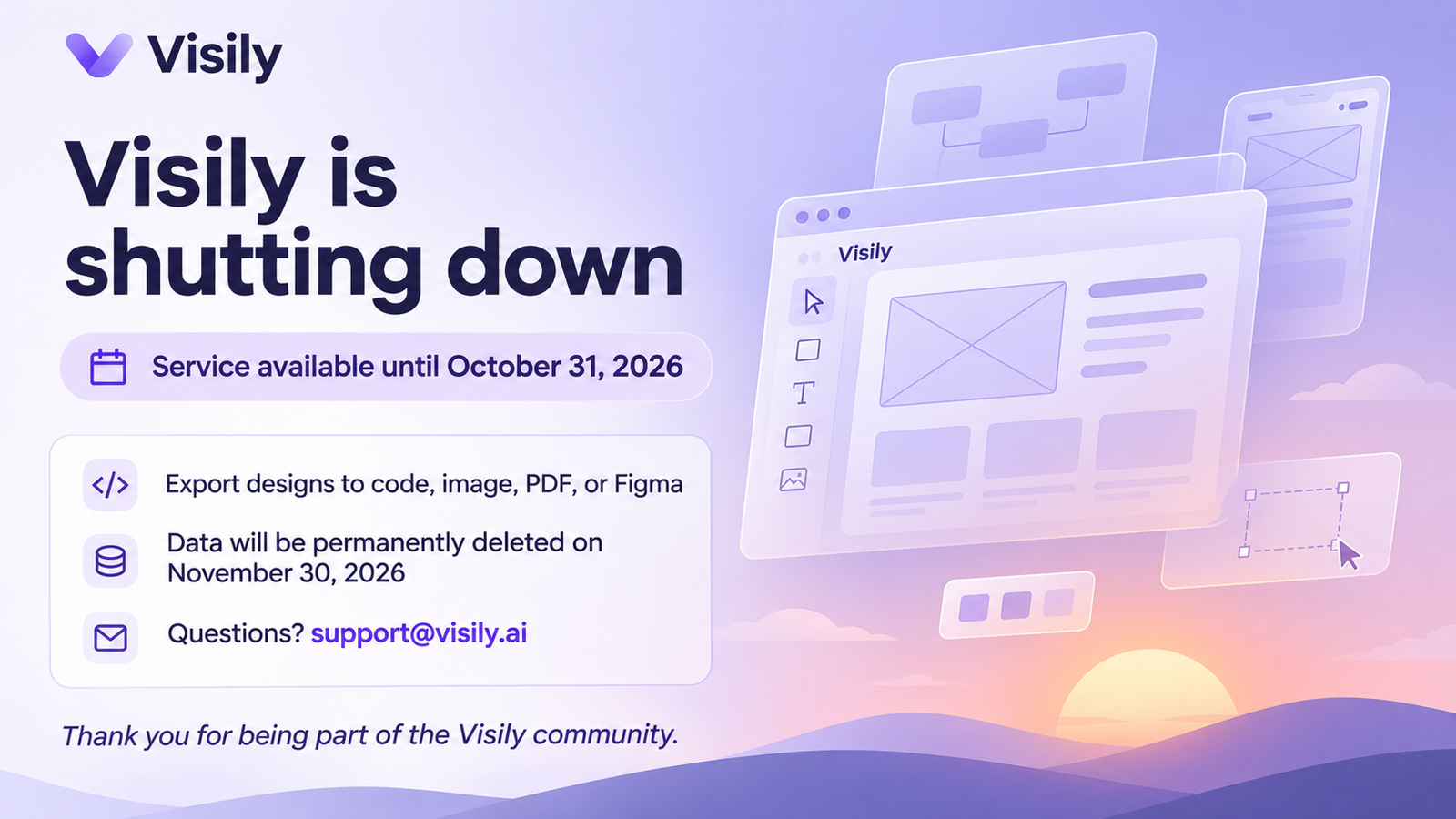
On October 3, 2026, the Visily team published an official announcement confirming that the platform would close on October 31, 2026.
According to the company’s statement, the market for design tools had changed substantially over the preceding years.
After evaluating its options, the team decided that shutting down was the appropriate course of action.
The official statement did not provide detailed financial or operational reasons behind the decision.
However, the announcement comes during a period of rapid change in AI-powered product design.
The broader industry is experiencing several important developments:
1. Increasing Competition in AI Design
AI features are becoming more common across design and development platforms.
Tools such as Figma, Uizard, and other AI-assisted design solutions are changing how teams create interfaces and prototypes.
As more platforms introduce AI capabilities, standalone AI design products must continually differentiate themselves.
2. Growing Expectations for Design-to-Development Workflows
Modern product teams increasingly expect more than simple wireframe generation.
They want solutions that support the complete workflow, from initial concepts and prototypes to developer handoff and production-ready interfaces.
This creates additional pressure on design platforms to offer seamless integrations and sophisticated functionality.
3. Rapidly Changing AI Technology
The capabilities of generative AI continue to evolve.
Features that once made a product distinctive can become widely available across competing applications.
For AI-powered software businesses, maintaining a clear competitive advantage is becoming increasingly challenging.
These industry trends provide context, although they should not be treated as confirmed individual causes of Visily’s closure.
Important Visily Shutdown Dates
If you previously used Visily, the following dates are particularly important.
| Date | Announcement |
|---|---|
| October 3, 2026 | Visily announced its shutdown |
| October 31, 2026 | Final scheduled day of service |
| November 30, 2026 | Permanent deletion of user data |
Important: Visily’s guaranteed access and export period ended on October 31, 2026. The November 30 date is the data deletion deadline, not an extension of service availability.
What Happens to Existing Visily Designs?
One of the biggest concerns for former Visily users is the status of their existing projects.
Visily announced that user data would be permanently deleted on November 30, 2026.
Before the shutdown, the platform supported several export methods, including:
- Exporting interface designs as images.
- Downloading project layouts as PDF files.
- Exporting supported designs to code.
- Transferring designs to Figma.
- Retrieving certain assets using the Visily MCP server.
Because the service shutdown date has passed, users should not assume these export methods are still operational.
If you have not preserved your designs, contact Visily support at support@visily.ai to ask whether any recovery options remain.
If you already exported your work, keep secure backups and confirm that the files open correctly in your new design environment.
Top 5 Visily Alternatives in 2026
Although Visily is no longer available, several platforms support wireframing, prototyping, and interface design.
Here are five alternatives worth exploring.
1. Figma — Best for Collaborative UI/UX Design
Website: https://www.figma.com/
Figma is a widely used interface design and prototyping platform for professional designers and product teams.
Its strengths include reusable design systems, collaborative workflows, interactive prototypes, and developer handoff.
For teams that have already exported their Visily designs to Figma, continuing work there may be a practical option.
Best for: Professional UI/UX designers, agencies, SaaS teams, and collaborative product development.
2. Uizard — Best for AI-Assisted Wireframing
Website: https://uizard.io/
Uizard focuses on simplifying interface design with AI-powered functionality.
Its workflows can help users move from early ideas, prompts, or visual references into interface concepts.
For non-designers who appreciated Visily’s accessibility, Uizard is worth evaluating.
Best for: Startup founders, product managers, and teams exploring early-stage application concepts.
3. Penpot — Best for Open-Source Design Workflows
Website: https://penpot.app/
Penpot is an open-source design and prototyping platform that supports collaboration between designers and developers.
It provides an alternative for organizations interested in open technologies and greater control over their design infrastructure.
Best for: Development teams, open-source enthusiasts, and businesses seeking flexible design workflows.
4. Balsamiq — Best for Simple Wireframes
Website: https://balsamiq.com/
Balsamiq is a wireframing tool focused on low-fidelity interface planning.
Rather than emphasizing polished visuals, it helps teams concentrate on screen layouts, information architecture, and user journeys.
It can be useful during the earliest stages of website or application planning.
Best for: UX planning, stakeholder discussions, and rapid low-fidelity wireframing.
5. Framer — Best for Website Design and Publishing
Website: https://www.framer.com/
Framer combines visual website design with publishing capabilities.
While it is not a direct replacement for every Visily workflow, it can be valuable for teams designing marketing websites, landing pages, and interactive web experiences.
Best for: Website designers, startups, and teams developing modern marketing websites.
How to Choose the Right Visily Alternative
Before switching to a new design platform, consider the following questions:
Do you need AI-generated designs?
If creating layouts from prompts or visual references is essential, prioritize platforms with AI-assisted design functionality.
Are you designing websites or mobile applications?
Different tools specialize in different outcomes. Some focus on interface design, while others are better suited to website publishing.
Does your team need collaboration?
Look for shared workspaces, commenting, version history, and reusable design systems.
How will developers use your designs?
Evaluate the platform’s export formats, integrations, and developer handoff capabilities.
Can you safely preserve your work?
Choose tools that support portable formats and practical backup procedures to reduce dependence on a single provider.
What the Visily Shutdown Means for the Future of AI-Powered Design
The Visily shutdown is an important reminder that rapid innovation does not automatically guarantee long-term product sustainability.
AI design technologies are becoming more capable, but businesses must also offer reliable workflows, effective user experiences, and sustainable products.
For designers and agencies, this highlights an important principle:
AI should enhance the design process, not become the only foundation of it.
Successful digital products still require:
- Clear UX strategy and research.
- Strong visual design and branding.
- Accessibility and responsive layouts.
- Effective collaboration between designers and developers.
- Reliable development and maintenance processes.
Even as AI tools evolve, these fundamentals remain essential.
How Codmash Software Solutions Can Help
At Codmash Software Solutions Pvt. Ltd., we understand the importance of creating digital products that deliver strong user experiences and remain maintainable as technologies change.
Our team works with businesses to transform ideas, wireframes, and design concepts into functional digital experiences.
Our Services Include
- UI/UX Design: User-focused website and application interfaces.
- Figma Design and Prototyping: Professional interface layouts and interactive prototypes.
- Website Development: WordPress, Shopify, Webflow, and custom websites.
- Custom Web Applications: React, Next.js, Laravel, and Node.js solutions.
- Mobile App Development: Responsive, user-friendly mobile experiences.
- Design-to-Code Development: Turning approved designs into functional websites and applications.
If your organization is transitioning away from Visily or another discontinued design tool, we can help assess your existing files, organize the available design assets, and plan the next development steps.