Recent posts
-
Small Device, Big AI – What NVIDIA’s Jetson Orin Nano Super Makes Possible
October 31, 2026
-
PHP Security in Practice: Vulnerabilities, Defenses, and Secure Development
October 27, 2026
-
UI/UX Design With AI Tools: 7 Powerful Trends Transforming Product Design in 2026
September 17, 2026
-
AI Lead Generation in 2026: How to Turn Your Website Into a 24/7 Sales System
September 7, 2026
-
Affordable Website Development Services-How to Build a Quality Website Without Overspending
August 4, 2026
PHP remains one of the most widely used server-side programming languages, supporting websites, content management systems, online stores, and business applications. Its broad adoption makes PHP security a practical concern for organizations of every size. However, the language itself does not determine whether an application is secure. Risk depends on how developers design and write software, how servers and frameworks are configured, and how systems are maintained after deployment. Secure outcomes require attention across the application lifecycle, from initial requirements and coding decisions through testing, release, and ongoing operations.
A vulnerability is a weakness in software, configuration, or operational practice that could be used to violate intended security controls. Not every weakness can be exploited in every environment, but an attacker may combine flaws with exposed services, weak credentials, or outdated components to gain access or disrupt a system. The consequences can extend well beyond technical defects. Compromised user accounts may expose personal information; attacks against business data can interrupt work or create financial and regulatory costs; and service outages can prevent customers from using a site. A visible incident may also damage trust and organizational reputation.
Understanding PHP security therefore means considering both common application risks and the safeguards that reduce them. This post examines issues such as unsafe handling of user input, access-control failures, insecure file operations, and vulnerable dependencies, alongside practical defenses including validation, prepared database queries, secure session settings, and careful configuration. It also addresses secure maintenance: monitoring updates, testing changes, limiting access, and responding promptly when weaknesses are discovered. Finally, responsible communication matters. Organizations should document findings clearly, protect sensitive details, and coordinate disclosure so that affected parties can address a problem before unnecessary exposure increases the risk.
Vulnerabilities can enter a PHP application wherever data, identity, software components, or operating conditions are handled without sufficient safeguards. A common source is unsafe treatment of user input. Data from forms, URL parameters, cookies, uploaded files, and external services may be malformed or deliberately hostile. If an application uses that data in database queries, HTML output, file paths, or system commands without appropriate validation, parameterization, or context-aware encoding, attackers may exploit injection flaws, cross-site scripting, or unauthorized file access.
Authentication and access control are another frequent source of risk. Weak password policies, insecure session management, exposed credentials, or missing checks on individual actions can allow account takeover or access to information a user should not see. A successful login alone is not proof that every later request is authorized; applications must verify permissions consistently, including for administrative functions and sensitive records.
Risks also arise from software that is no longer maintained. Unsupported PHP releases may lack security fixes, while outdated frameworks and third-party packages can contain publicly known vulnerabilities. Even maintained dependencies require careful selection and updates, since a flaw in a widely used library can affect many applications. Framework protections are valuable, but they do not automatically make application code safe.
Some weaknesses originate outside the PHP source itself. Permissive file permissions, exposed configuration files, poorly restricted database accounts, insecure web-server settings, and incorrectly configured hosting services can undermine otherwise careful code. Deployment practices matter as well: secrets placed in repositories, debug output enabled in production, or patches applied inconsistently can expose systems.
Finally, application logic can create security gaps even when individual components behave as designed. Incorrect assumptions about ownership, transaction order, or business rules may let users bypass limits or alter another user’s data. These issues are often specific to how a service works and require tests and reviews that reflect real workflows. Effective assessment therefore examines the complete stack: custom PHP code, frameworks, libraries, infrastructure, configuration, and the processes used to build and deploy the application.
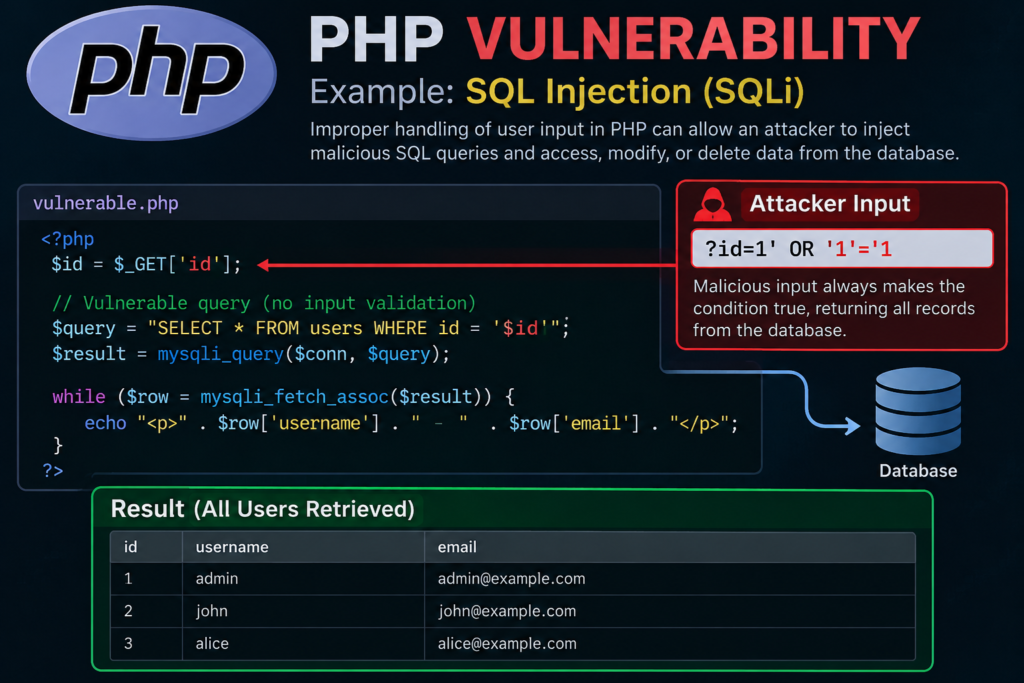
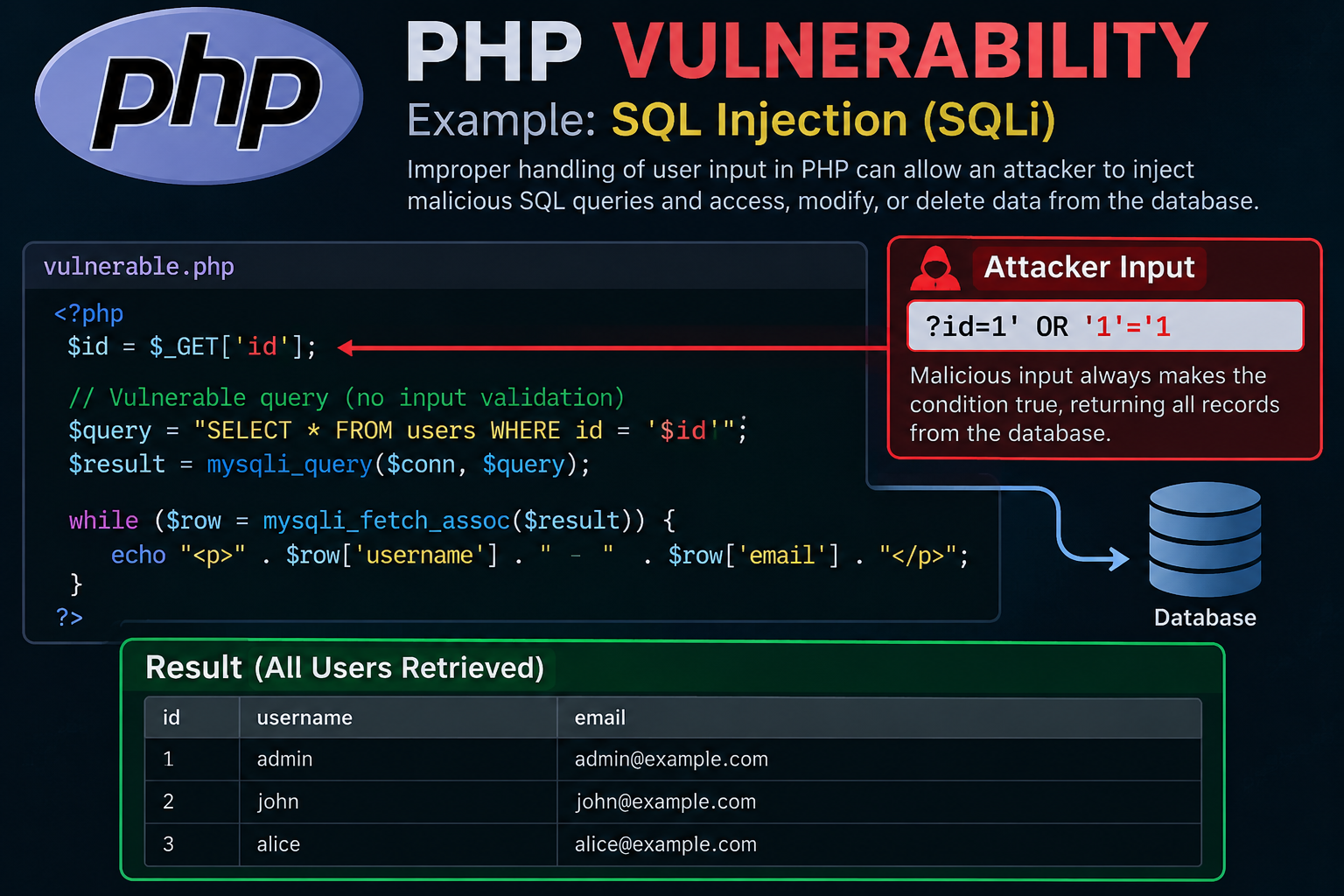
Data supplied by users, external services, or stored records must be treated as untrusted, even when it appears ordinary. A value can become dangerous when PHP combines it with instructions for a database, operating system, filesystem, or browser. The risk includes unexpected characters, formats, or lengths that change how a program interprets an operation. SQL injection occurs when input is concatenated into query text, potentially altering the intended database command. Consequences may include unauthorized reading, changing, or deleting records, and exposure of sensitive information. Unsafe shell commands or file paths can likewise cause unintended system actions or access beyond permitted locations.
Parameterized queries are a primary defense against SQL injection. They keep query structure separate from supplied values, so the database handles input as data rather than executable SQL. Developers should use a database library’s parameter-binding features consistently, including for filters and search terms. Dynamic parts of a query, such as column names or sort directions, generally cannot be bound as values; choose them from a strict, predefined allowlist instead. Avoid passing user-controlled strings to shell execution or dynamic-code functions. When system tasks are necessary, prefer safer APIs, fixed command structures, and carefully constrained arguments.
Cross-site scripting occurs when untrusted content is rendered in a browser as active markup or script, potentially allowing actions in a user’s session or exposing page data. Escape output for its specific context, such as HTML text, an HTML attribute, or a JavaScript string, using suitable encoding functions; escaping for one context does not necessarily protect another. Validation and escaping serve different purposes: validation checks whether input meets accepted rules, while escaping protects data at the point it is used in a particular output context. Apply strict validation to expected types, lengths, and formats, but do not rely on validation alone. Together, these practices reduce the chance that input will be interpreted as instructions.
Secure login systems begin with careful credential handling. Never store passwords as plaintext or use reversible encryption: a database breach could expose every account. PHP provides password_hash() to create salted password hashes and password_verify() to check submitted credentials. Use a supported algorithm and let PHP manage the salt; when users log in, password_needs_rehash() can help update hashes as settings or recommended algorithms change. Require sensible password lengths, avoid needless complexity rules that encourage predictable choices, and do not reveal whether a failed login resulted from an unknown username or an incorrect password.
Protect accounts against automated guessing by limiting repeated login attempts, applying progressive delays or temporary lockouts, and monitoring suspicious activity without making denial of service against legitimate users easy. Multi-factor authentication adds another barrier and is especially valuable for administrators, financial functions, and other high-impact accounts. Recovery flows need equal care: use short-lived, single-use tokens generated with secure randomness, store token hashes where practical, and deliver them through verified channels. Do not send existing passwords, rely on security questions as the sole proof of identity, or allow recovery links to remain valid indefinitely.
Sessions must be protected from interception and fixation. Serve the entire site over HTTPS and configure session cookies with the Secure and HttpOnly attributes; choose a SameSite value that fits the application’s cross-site needs, using stricter settings where compatible. Regenerate the session ID after successful authentication and whenever privileges change, then invalidate the old session. Set reasonable idle and absolute expiration limits, and destroy server-side session data during logout. Authentication establishes who a user is; authorization determines what that user may do. Enforce authorization on the server for every sensitive request, not merely by hiding buttons or relying on page navigation. Check ownership and role permissions each time an action is performed, deny access by default, and avoid trusting user-supplied role or identity values. Consistent checks reduce the risk that a valid account can access another user’s records or perform administrative operations without permission.
File uploads create risk when an application accepts content without controlling what users can submit or how that content is stored. Set reasonable limits on request and file size, and allow only file types required by the application. Do not rely on a filename extension or the MIME type supplied by a browser: both can be forged. Validate file content using suitable server-side inspection, while recognizing that file signatures alone do not make a file safe. Where appropriate, use malware scanning and reject malformed or unexpected content. Return clear errors without exposing internal paths or implementation details.
Never use a user-provided filename as the storage name or as a filesystem path. Generate an unpredictable server-side filename, retain only a validated extension when needed, and store the original name separately if the application must display it. Prefer storing uploads outside executable, publicly accessible web directories. If public retrieval is required, serve files through application code that checks authorization and sets safe response headers. Apply least-privilege permissions so the web process can perform only necessary read and write operations; upload directories should not permit execution. These controls reduce the impact of malicious files and limit access if a weakness is discovered.
User-controlled paths can also enable path traversal, allowing an attacker to use sequences such as ../ to reach files beyond an intended directory. Avoid constructing filesystem paths directly from request values. Map user choices to server-defined identifiers or allowlisted filenames, normalize and resolve paths, and verify that the final resolved path remains within the intended base directory before accessing it. Server-side request forgery (SSRF) occurs when an application makes a network request to a destination influenced by a user. An attacker may target internal services or cloud metadata endpoints. Prefer strict destination allowlists, validate schemes and hosts, and block access to private and link-local network ranges where feasible. Apply network-level egress controls as an additional safeguard, and avoid forwarding credentials or sensitive headers to untrusted destinations. Redirects and DNS resolution should also be considered when enforcing destination rules.
Production configuration is a core layer of PHP security, not an afterthought to application code. Run a currently supported PHP release and apply security updates promptly; unsupported versions no longer receive fixes for newly discovered flaws. Remove or disable extensions, modules, and services that the application does not need, reducing the number of exposed components. Keep development settings out of production: disable debug modes, development tools, and public diagnostic endpoints before deployment. Review the web server and PHP-FPM configuration as well as application settings, since unsafe defaults or overly broad access can undermine otherwise sound code.
Do not display detailed errors to visitors. Error messages and stack traces can reveal file paths, software versions, database details, or other information useful to an attacker. Configure production PHP to suppress displayed errors while recording useful diagnostics in protected logs. Restrict log access, avoid writing credentials or sensitive personal data into logs, and establish appropriate retention and monitoring. Store configuration files and secrets outside publicly served directories, and ensure they cannot be fetched directly through the web server. Use a secure secret-management process, limit access to credentials, and rotate them when exposure is suspected.
Separate development, testing, and production environments so that debug settings, test accounts, and sample data do not carry into the live service. Use HTTPS throughout, redirect HTTP requests where appropriate, and configure secure transport settings at the web-server or load-balancer layer. Apply carefully scoped file and process permissions: the web-service account should have only the access needed to run the application, with write access limited to specific upload, cache, or temporary directories. Avoid granting broad ownership or permissions for convenience. As part of every deployment, verify PHP-FPM pool users, environment-variable handling, exposed paths, and server rules, then test that private files and administrative tools are inaccessible from the public internet.
Third-party packages can accelerate PHP development, but each dependency also adds code that may contain vulnerabilities, receive unsafe updates, or become unmaintained. Dependency management is therefore a core part of application security, not merely a way to install libraries. Before adding a package, review its source, ownership, release history, issue activity, and maintenance status. Prefer reputable projects with transparent security practices, and confirm that a package is necessary and compatible with the application’s supported PHP versions. Use Composer to declare dependencies and keep the composer.lock file under version control so deployments use known, reproducible versions. Avoid installing packages directly from unverified sources or allowing production systems to resolve uncontrolled versions.
Maintain visibility into known vulnerabilities by monitoring security advisories for the packages in use and routinely checking the dependency tree for outdated or affected components. Composer’s audit capabilities can help identify packages with published advisories; automated alerts and regular review can make findings easier to address promptly. Remove packages that are no longer needed, since unused dependencies still increase the application’s attack surface and may complicate updates. Establish a recurring update schedule, with more frequent checks for security fixes, rather than postponing maintenance until an incident occurs. Updates should be tested in a controlled environment before deployment, including relevant automated tests and checks for compatibility or unexpected behavior.
When an advisory affects a dependency, first determine which versions are vulnerable and whether the application uses the affected functionality. Assess exposure in context, including whether the affected component is reachable, what data or operations it can access, and the likely business impact. Prioritize remediation according to severity, exploitability, exposure, and operational consequences. Upgrade to a fixed version where possible; if an immediate patch is unavailable, apply a documented mitigation, such as disabling an exposed feature or restricting access. Verify the change by confirming the installed version, rerunning security checks, and testing application behavior. Record the advisory, assessment, decision, remediation, verification results, and any remaining risk. A consistent process helps teams respond efficiently and provides a clear record for future reviews.
Effective PHP security depends on a layered process that finds weaknesses early and reduces the impact of flaws that escape detection. Combine careful code review with static analysis, dependency scanning, automated tests, and configuration checks rather than relying on a single tool or final review. Code review can identify unsafe input handling, weak authorization logic, and inappropriate use of sensitive data. Static analyzers can flag suspicious patterns, while dependency scanners help identify known vulnerabilities in third-party packages. Review findings in context: tools can produce false positives, miss design problems, or overlook how separate components interact, so qualified human judgment remains essential.
Automated tests should verify both expected application behavior and security boundaries. Test that users can complete permitted actions, and that they cannot access another user’s records, invoke restricted functions, or bypass authorization by changing request parameters. Include checks for validation, authentication, session handling, and error behavior where relevant. Review application and server configuration as well, including debug settings, exposed files, transport security, and permissions. Run security tests only with explicit authorization and in controlled environments that avoid exposing real users or production data to disruption.
Secure development standards make these practices consistent across a team. Establish clear guidance for handling input, encoding output, managing secrets, using prepared statements, and enforcing access controls. Peer review should be part of the development workflow, with security-sensitive changes receiving particular attention. Keep production privileges to the minimum needed for each application, service, and account; limit database permissions and avoid running PHP processes with unnecessary operating-system access. Separate environments and protect credentials to reduce the consequences of a compromised component.
Finally, treat monitoring and logging as continuing safeguards, not substitutes for prevention. Centralize logs where practical, restrict access, protect records from unauthorized alteration, and avoid recording passwords, tokens, or unnecessary personal data. Monitor for unusual login patterns, repeated authorization failures, unexpected file changes, and abnormal application errors. Define who reviews alerts and how incidents are escalated. Regularly reassess code, dependencies, configuration, and monitoring as the application changes, documenting findings and tracking corrective work to completion.
PHP security is most useful when explained in terms each audience can act on. Developers need clear technical expectations, such as input validation, output encoding, and timely dependency updates. Business owners and clients need to understand how these practices reduce the likelihood and potential impact of a breach. Prospective users may care most about protecting account details, supporting safer transactions, and keeping services available. Tailor the explanation to the audience without changing the underlying facts.
Translate technical risks into practical outcomes, while avoiding guarantees. For example, say that parameterized database queries help reduce SQL injection risk, rather than claiming that they make an application immune to attack. Explain that strong authentication can make unauthorized account access harder, and that backups and monitoring can support recovery and service reliability. These measures lower risk; they do not remove it.
Describe security practices in specific, verifiable terms. State which PHP versions are supported, how often dependencies are reviewed, and how vulnerabilities are assessed and addressed. Explain relevant safeguards, such as restricted server permissions, secure session settings, encryption in transit, and access controls, when they are in place. Be equally clear about the scope of those controls: protections may differ across environments, and no single measure covers every threat.
Set realistic maintenance commitments. Identify who is responsible for updates, how urgent issues are handled, and how customers or stakeholders will be notified when an incident affects them. Avoid absolute claims such as “completely secure” or “unhackable.” Transparent communication builds trust more reliably than promises that cannot be substantiated. Review security descriptions as the application, its dependencies, and its operating environment change.
Use this checklist to prioritize work: maintain a supported PHP version; validate input and encode output appropriately; require strong authentication; restrict file, database, and system permissions; update and review dependencies; and conduct ongoing security reviews, testing, and monitoring. Assign an owner and a review schedule to each item. This makes security responsibilities visible and helps teams explain both current protections and remaining limitations clearly.