Recent posts
-
UI/UX Design With AI Tools: 7 Powerful Trends Transforming Product Design in 2026
September 17, 2026
-
AI Lead Generation in 2026: How to Turn Your Website Into a 24/7 Sales System
September 7, 2026
-
Affordable Website Development Services-How to Build a Quality Website Without Overspending
August 4, 2026
-
AI in Software Development 2026: Trends, Benefits & Use Cases
February 28, 2026
-
The Future of Web and App Development: Building Digital Platforms That Grow With Your Business
December 25, 2025
Top IT Trends Shaping 2025 are changing how businesses automate operations, protect digital assets, build applications, manage data and create customer experiences. From artificial intelligence and cloud computing to cybersecurity, 5G, edge computing and the Internet of Things, technology is becoming more deeply connected with everyday business strategy.
Understanding the Top IT Trends Shaping 2025 is important for companies that want to improve efficiency, reduce operational costs and build digital platforms that can adapt to future growth. The most valuable technologies are not necessarily the newest ones; they are the technologies that solve real business problems and can be implemented securely and strategically.
This guide explores 10 of the Top IT Trends Shaping 2025, explains how each technology works and looks at practical ways businesses can use these developments to support digital transformation, customer experience and long-term growth.
In today’s rapidly IT Trends evolving digital landscape, businesses must stay ahead of technological advancements to remain competitive. With AI-driven tools revolutionizing operations, decision-making, and customer experiences, companies now have the ability to analyze large datasets, automate processes, and gain actionable insights like never before. The year 2025 promises a host of innovations that are set to redefine industries, streamline operations, and transform customer experiences. Companies that proactively embrace these trends, including AI technology, can gain a significant advantage, driving both growth and innovation while improving user satisfaction.
This comprehensive guide explores the most impactful IT trends of 2025 and provides insights on how businesses can harness these technologies effectively.
Table of Contents
- AI-Driven Automation
- Cybersecurity
- Cloud Computing
- 5G Connectivity
- Blockchain Technology
- Edge Computing
- Quantum Computing
- AR and VR
- Internet of Things
- Robotic Process Automation
- What Businesses Should Do Next
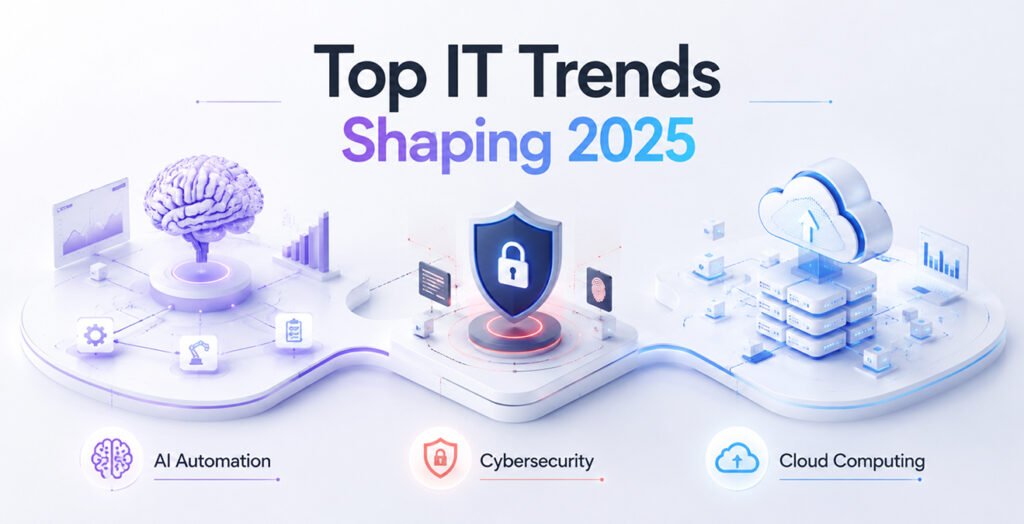
Top IT Trends Shaping 2025: AI-Driven Automation
Artificial Intelligence (AI) has emerged as a cornerstone of modern business strategies. Its ability to automate repetitive tasks, analyze large datasets, and provide actionable insights makes it indispensable. AI-driven solutions are transforming customer engagement through chatbots and virtual assistants that offer round-the-clock support, personalized recommendations, and instant responses. Brands such as Sephora and H&M have successfully deployed AI chatbots to enhance customer experiences and increase engagement.
Beyond customer service, AI enables predictive analytics, helping businesses anticipate market trends, optimize marketing campaigns, and uncover growth opportunities. In finance and human resources, AI automates routine processes such as payroll, invoice management, and onboarding, allowing employees to focus on higher-value tasks.
By leveraging AI, businesses can achieve operational efficiency, reduce costs, and make data-driven decisions that foster growth. Companies that fail to adopt AI risk falling behind competitors who are already using these tools to gain a strategic advantage.
Businesses looking to introduce intelligent workflows can explore Codmash AI Automation Services.
Cybersecurity: Protecting Digital Assets
Cybersecurity remains one of the Top IT Trends Shaping 2025 because businesses are managing more cloud infrastructure, customer data and connected systems than ever before.
Cybersecurity remains a critical concern as cyberattacks become more sophisticated and frequent. With global cybercrime projected to reach over $10 trillion annually by 2025, organizations must invest in advanced security measures to protect sensitive data and maintain trust.
Modern cybersecurity strategies include zero-trust architecture, AI-powered threat detection, and compliance with regulations like GDPR and CCPA. AI systems can monitor networks in real time, identifying anomalies and preventing potential breaches before they cause damage. Businesses are also increasingly encrypting sensitive data and conducting regular security audits to ensure system integrity.
Companies like Microsoft and IBM are leading the development of AI-driven cybersecurity solutions that proactively mitigate threats. Effective cybersecurity not only protects digital assets but also safeguards a company’s reputation, which is vital for maintaining customer confidence.
Businesses can also refer to the NIST Cybersecurity Framework when building structured approaches to cybersecurity risk management.
Cloud Computing Among the Top IT Trends Shaping 2025
Cloud computing has transformed business infrastructure, offering scalable, flexible, and cost-effective solutions. By shifting from on-premises servers to cloud platforms, companies can reduce overhead costs while improving operational efficiency. Cloud computing enables real-time collaboration, facilitates remote work, and supports business continuity through robust backup and disaster recovery solutions.
SaaS platforms such as Salesforce and Slack allow teams to collaborate seamlessly across locations, while IaaS providers like AWS, Azure, and Google Cloud offer scalable computing resources. Businesses can launch applications quickly, scale resources on demand, and access critical data from anywhere, empowering them to respond faster to market changes.
Cloud computing also supports hybrid work environments, enabling organizations to maintain productivity and flexibility. By adopting cloud solutions, businesses gain the agility needed to innovate and compete in an increasingly digital world.
Organizations evaluating cloud infrastructure can review guidance and service models from Amazon Web Services when comparing scalable cloud environments.
5G Connectivity: Powering Next-Generation Services
Among the Top IT Trends Shaping 2025, 5G is particularly important for businesses developing connected applications that depend on low latency and real-time data exchange. Unlike previous generations, 5G supports real-time applications such as autonomous vehicles, smart cities, and IoT devices, creating new opportunities for innovation.
In healthcare, 5G enables remote surgeries and telemedicine by providing stable, low-latency connections. Smart cities leverage 5G to monitor traffic, energy consumption, and emergency services in real time, improving efficiency and sustainability. Autonomous vehicles rely on instant data transfer from sensors and infrastructure, enhancing safety and performance.
For businesses, 5G accelerates content delivery, improves collaboration, and enables immersive experiences through AR and VR applications. Early adoption of 5G technology positions companies as forward-thinking leaders, ready to capitalize on the next wave of digital innovation.
The GSMA provides further information about the development and business applications of 5G connectivity.
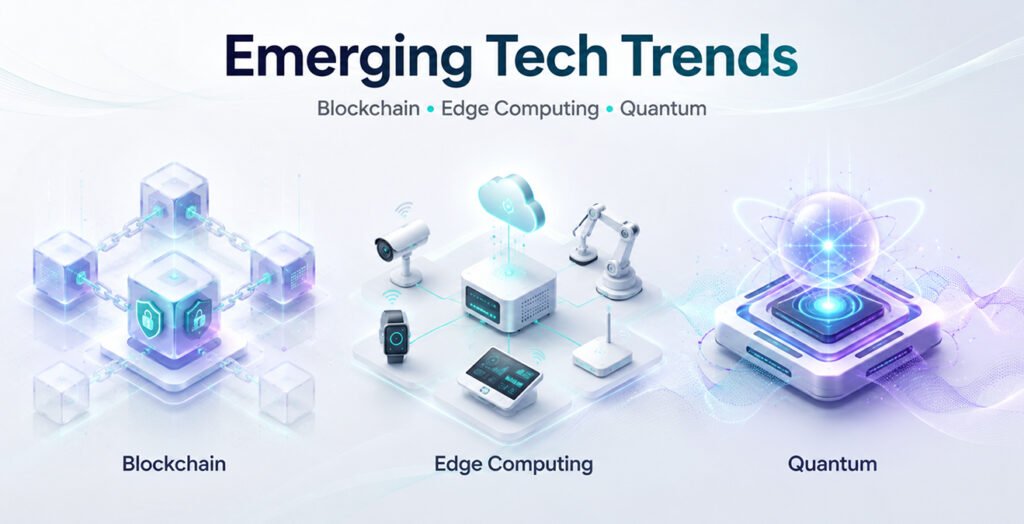
Blockchain Technology: Ensuring Transparency and Security
Blockchain has evolved beyond cryptocurrencies to provide secure, transparent, and efficient solutions for various industries. Its decentralized ledger system guarantees data integrity, reduces fraud, and enhances trust in digital transactions.
In supply chain management, companies like Walmart use blockchain to track products from origin to store, ensuring quality and accountability. In healthcare, blockchain secures patient records, allowing only authorized personnel to access sensitive data. Financial institutions utilize blockchain for faster, more secure cross-border transactions, reducing costs and settlement times.
Adopting blockchain technology improves transparency, operational efficiency, and security. It also helps companies build trust with clients, partners, and stakeholders, positioning them as reliable and innovative market leaders.
Edge Computing: Real-Time Processing at the Source
Edge computing processes data closer to the source, reducing latency and bandwidth usage while enabling faster decision-making. This technology is particularly beneficial for applications that require real-time responses, such as autonomous vehicles, industrial automation, and retail analytics.
In manufacturing, sensors monitor equipment to predict maintenance needs, preventing costly downtime. Retailers use edge computing to analyze shopper behavior instantly, optimizing layouts and product placement. Autonomous vehicles rely on edge computing to process onboard sensor data for safe navigation.
By combining edge and cloud computing, businesses can achieve a hybrid model that balances speed, scalability, and security, empowering them to innovate while maintaining operational efficiency.
Quantum Computing: Unlocking Advanced Problem-Solving
Quantum computing uses qubits to perform complex calculations far beyond the capabilities of classical computers. Industries such as pharmaceuticals, finance, and logistics are exploring quantum computing for optimization, simulation, and predictive modeling.
Quantum algorithms accelerate drug discovery, reduce research timelines, and optimize logistics operations by analyzing vast datasets. Financial institutions use quantum computing to manage risks, forecast market trends, and optimize portfolios efficiently. Although still in its early stages, businesses that invest in quantum solutions now are likely to gain a significant competitive advantage in the near future.
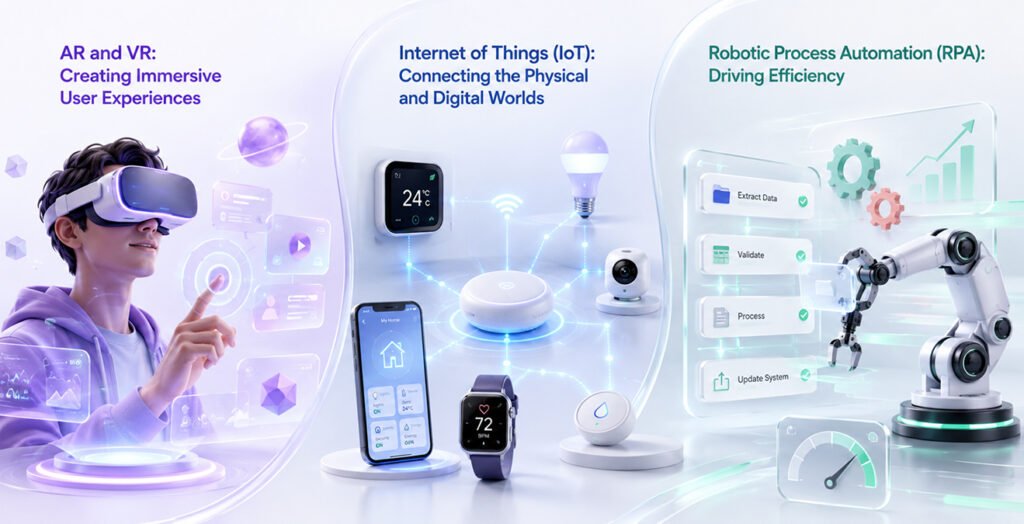
AR and VR: Creating Immersive User Experiences
Augmented Reality (AR) and Virtual Reality (VR) offer immersive experiences that transform how businesses engage with customers. Retailers use AR apps to let customers visualize products in their homes before purchase, while VR provides interactive training environments and virtual property tours in real estate.
These technologies enhance customer engagement, improve brand recall, and reduce operational costs by minimizing the need for physical prototypes or training spaces. As AR and VR become more accessible, businesses across sectors are discovering innovative ways to deliver high-impact experiences that drive satisfaction and loyalty.
Internet of Things (IoT): Connecting the Physical and Digital Worlds
IoT remains part of the Top IT Trends Shaping 2025 because connected devices allow organizations to monitor equipment, environments and customer interactions continuously.
The Internet of Things (IoT) links devices and systems, enabling data collection, remote monitoring, and automation. From smart homes to industrial equipment, IoT provides insights that improve efficiency and customer experiences.
In industrial applications, sensors detect equipment issues before they cause downtime. Wearable devices in healthcare track vital signs and share real-time data with medical professionals. Smart homes use IoT to optimize energy consumption and automate appliances.
IoT adoption empowers businesses to make data-driven decisions, reduce costs, and deliver personalized services, creating value for both companies and customers.
Robotic Process Automation (RPA): Driving Efficiency
RPA automates repetitive tasks, allowing employees to focus on high-value, strategic work. Finance departments use RPA for invoice processing, account reconciliation, and regulatory reporting, while HR teams streamline onboarding, payroll, and benefits management. Customer service benefits from automated responses to frequently asked questions, freeing agents to handle complex queries.
By implementing RPA, businesses can increase productivity, reduce errors, and scale operations without significantly increasing costs. RPA adoption not only improves efficiency but also enhances the overall customer experience by ensuring faster and more accurate service delivery.
Top IT Trends Shaping 2025: What Businesses Should Do Next
The Top IT Trends Shaping 2025 demonstrate how quickly technology is becoming integrated into everyday business operations. AI and automation are improving efficiency, cloud platforms are making infrastructure more flexible, cybersecurity is becoming a core business requirement, and technologies such as 5G, IoT and edge computing are enabling increasingly connected digital experiences.
The important question for businesses is not whether every emerging technology should be adopted. The better question is which technologies solve a measurable problem, improve customer experience or create long-term operational value.
At Codmash, we help businesses turn technology strategy into practical digital solutions through AI automation, custom software development, web application development, mobile app development and modern website development. Rather than implementing technology in isolation, our focus is on building systems that support business goals and future growth.
If your organization is evaluating new technology or planning a digital transformation project, contact Codmash to discuss which solutions make sense for your requirements.